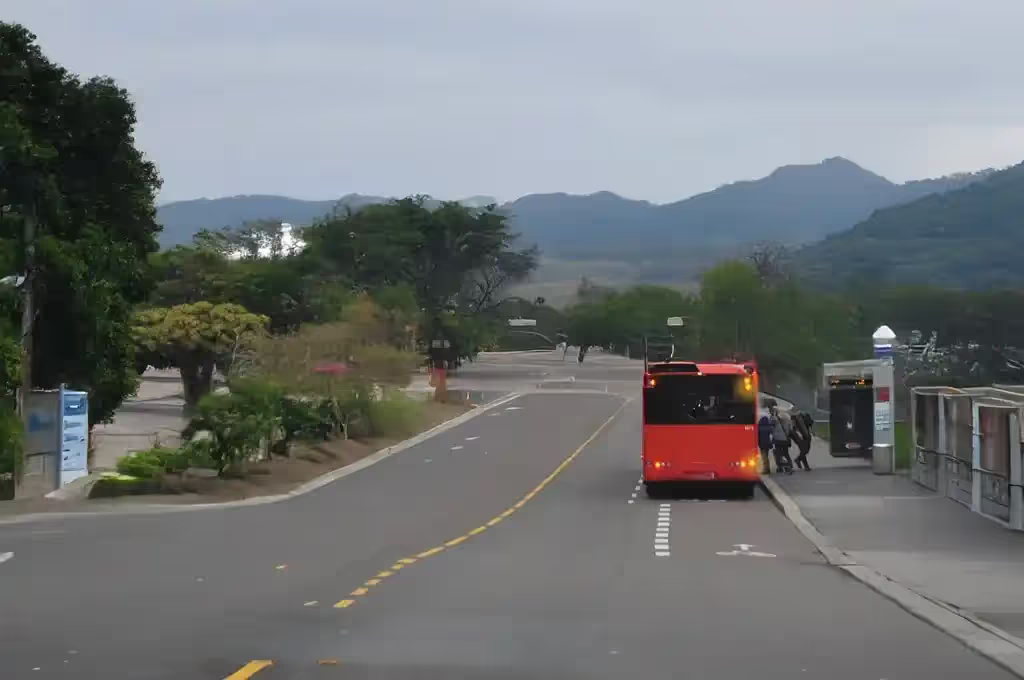
How should you pass the bus here?
Explanation
When a bus has stopped or is about to stop at a bus stop, you must pass at a particularly low speed (walking speed) and be able to stop immediately if necessary. The reason is reduced visibility and the risk that passengers, especially children, may step out in front of the bus, or that the bus may suddenly pull out. Even though the bus is required to yield when leaving the stop, that does not relieve you of the duty to slow down significantly. Therefore, pass at walking speed, look far ahead with your foot ready on the brake, and be prepared to stop. Increasing or maintaining your speed leaves too little safety margin. A complete stop is not always necessary, but you must stop if the situation requires it. The same strict speed requirement also applies when passing children by the road, school patrols, people with a white cane or a guide dog, and others who may have reduced abilities in traffic.
You’re driving in the right lane and see the sign “Lane ends.” Who must yield?
Explanation
The “Lane Ends” sign indicates that the right lane is ending. The red arrow marks the lane that ends, and drivers in this lane must yield to traffic in the lanes marked with black arrows. If you are in the right lane, you must adjust your speed, use your turn signal, and change lanes only when there is a sufficient gap, stopping if necessary. This is not a merge; the zipper rule applies only where the “Merging” sign is posted. Therefore, traffic in the center or left lane does not have to yield—you in the right lane must yield.
You’re stopped at a red light at an intersection. What is correct here?
Explanation
Signals and instructions from the police take precedence over traffic lights, signs, and normal right-of-way rules. When the police are directing traffic, you should ignore a red light and follow their instructions. However, you must not drive until you receive a clear go-ahead, for example, when the officer waves you through. Therefore, it is correct that you may drive through the intersection when the police officer waves. It is not correct to let crossing traffic with a green light decide (the lights are set aside), you should not apply right-hand priority when the police are directing, and you do not need to wait for the officer to physically turn toward you if you have already been given a clear signal to proceed.
What does this sign indicate?
Explanation
The sign is an informational sign called “optional lane.” It means both lanes can be used in the same direction, and you are free to choose either the right or left lane. Signs that show the further course of the lanes usually have a white background, as opposed to other informational signs that are often blue. The sign does not require a lane choice and does not prohibit the use of either lane.
The correct answer is therefore that you can use either the right or the left lane. It is not the case that only the right or only the left lane may be used, and the sign does not mandate a left turn at the next intersection. Still, remember normal practice: keep to the right when appropriate and change lanes in good time with your turn signal where needed.
What does this sign mean?
Explanation
The sign is the stop sign. It requires a complete stop before you enter the intersecting road. You must stop at the stop line. If there is no stop line, stop just before the intersecting road where you have sufficient visibility. After stopping, you must yield to all traffic on the intersecting road from both directions, and you may only proceed when it is completely clear and you are not obstructing anyone. The sign does not make the road you are entering a priority road. Therefore, it is correct that you must come to a full stop and yield to traffic from both directions. The alternatives about a priority road, stopping without having to yield, or yielding only to the right are incorrect.
What do our users say?
We recommend all students to use eteo, a superb tool to pass the theory!
Practiced every day for about a week and passed the theory today with only two errors. The questions were very similar to what I got. Recommended to everyone taking the theory!
eteo is the only site that offers free theory tests that are enough to pass, so we recommend the site to everyone taking a driver's license. Most others only offer 10 questions or similar.
Eteo.no really helped me prepare for the Norwegian driving theory test. The questions felt like the real exam, the explanations were clear, and I passed on my first try.
Great tool for anyone serious about passing the driving theory exam. I liked tracking my progress and taking realistic mock exams. It works smoothly on mobile and desktop and made studying more effective.
Eteo.no was extremely helpful in preparing me for the theory test. The mock exams helped me get used to the question format and time pressure. I felt calm and well prepared on exam day thanks to all the practice.
Everything you need to know about the tractor theory test
About the theory test for class T
The tractor theory test (class T) is adapted for agricultural vehicles and their special characteristics. The test consists of 30 questions, and you must answer at least 25 correctly (83%) to pass. You have 30 minutes to complete it.
Curriculum and topics
The test covers traffic rules for agricultural vehicles, special safety requirements, tractor safety, driving with trailers and equipment, load securing, road surface and markings, as well as hazards when driving tractors on public roads.
Pass easily with Eteo
With Eteo you get specialized tractor tests covering all aspects of safe operation of agricultural vehicles. Practice thoroughly and pass with confidence!